In This Guide
- How a Finnish Sauna Works
- How an Infrared Sauna Works
- Finnish vs Infrared: Side-by-Side Comparison
- What Each One Actually Feels Like
- Benefits: What the Research Says
- Safety: Who Should Check With a Doctor First
- Which Should You Choose?
- Other Styles Worth Knowing
- Where to Try Both Styles in Australia
- Your First Session: Step by Step
- Frequently Asked Questions
- Find Your Sauna
Walk into almost any bathhouse, gym or recovery studio in Australia and you will be offered one of two kinds of heat: a traditional Finnish sauna or an infrared sauna. Both make you sweat and both can leave you feeling calm and loose, but they work in completely different ways, feel different on the body and suit different people.
This guide explains how each one works, what a session actually feels like, what the research does and does not say, and how to choose between them. At the end you will find venues in our directory where you can try both, often on the same visit.
Key Takeaways
- Finnish saunas heat the air to around 70–100°C using a stove and stones. Water on the stones creates bursts of steam called löyly.
- Infrared saunas warm your body directly with infrared panels, so the cabin stays cooler, around 45–65°C, and sessions run longer.
- Finnish is best for the classic hot–cold–rest ritual, social bathing and anyone who loves strong heat.
- Infrared is best for first-timers, private sessions and people who find high temperatures uncomfortable.
- The strongest long-term health research is on traditional Finnish sauna use. Infrared research is smaller and less conclusive.
How a Finnish Sauna Works
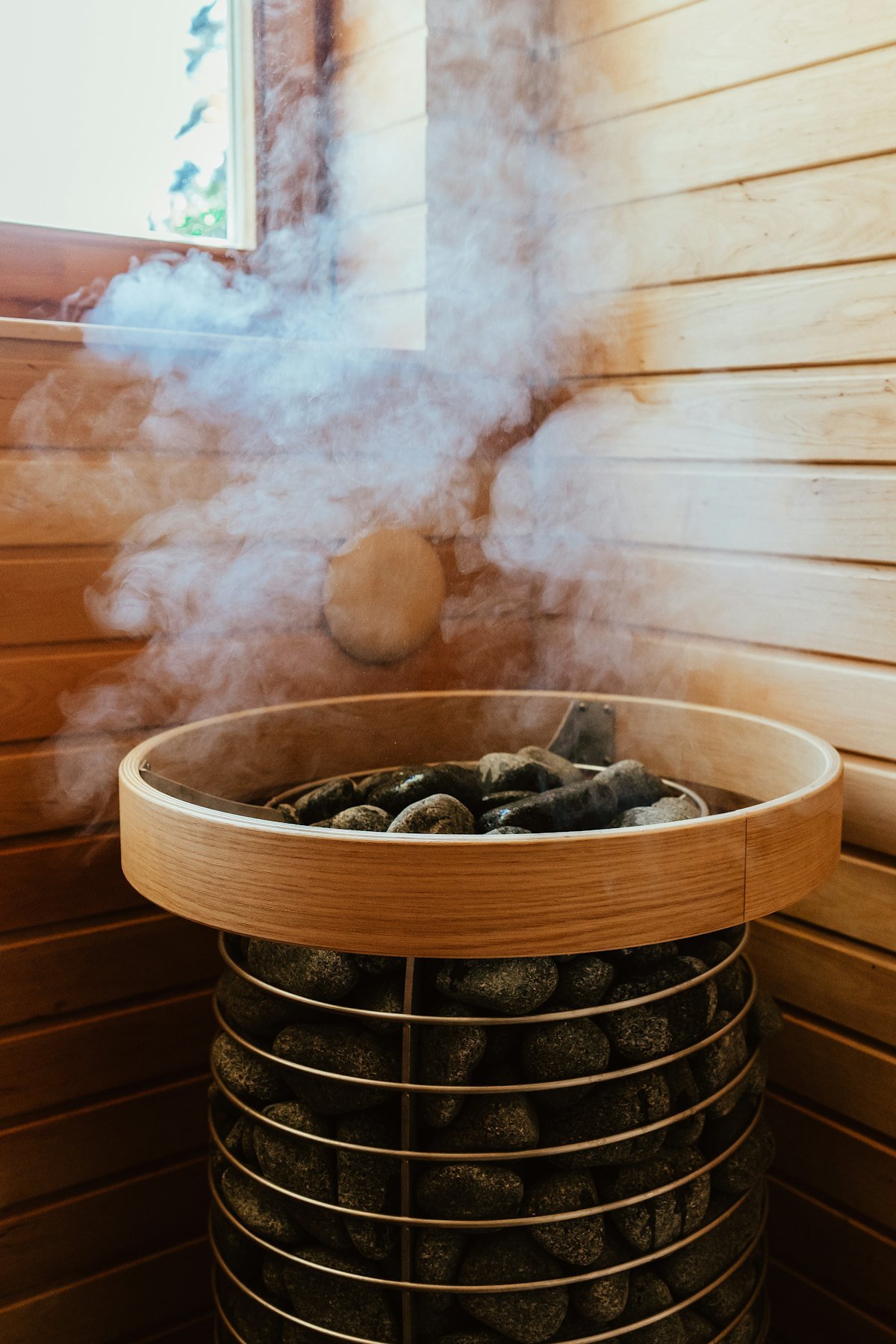
A Finnish sauna is a timber room, usually lined with spruce, cedar or aspen, with a heater in one corner topped by a pile of stones. The heater, which can be electric or wood-fired, warms the stones, and the stones warm the air. Air temperature in a typical Finnish sauna sits between 70 and 100°C, with the hottest air near the ceiling and the coolest near the floor. That is why most saunas have two or three levels of bench.
The defining feature is löyly (pronounced roughly “lur-loo”), the Finnish word for the wave of steam that rises when water is ladled onto the hot stones. Löyly briefly raises the humidity, and because moist air carries heat to your skin more effectively than dry air, it makes the room feel noticeably hotter for a minute or two. A good Finnish sauna lets you control the experience: dry and hot one moment, soft and steamy the next.
Electric, Wood-Fired and Hot-Stone Heaters
Most city bathhouses use electric heaters, which are easy to control and run all day. Wood-fired saunas burn timber to heat the stones and are prized for their soft, rolling heat and faint smell of woodsmoke; you will find them on beaches, lakes and pontoons from Sydney’s Northern Beaches to Tasmania’s waterways. Hot-stone saunas pack in a large mass of rock that stores a lot of heat and produces generous, even steam. They often run at the hotter end of the range.
In Australian listings you will see “Finnish sauna” and “traditional sauna” used almost interchangeably. Both describe a stove-and-stones sauna, as opposed to infrared. Browse our Finnish saunas and traditional saunas to see what is near you.
How an Infrared Sauna Works
An infrared sauna does not rely on hot air. Instead, panels or emitters in the walls give off infrared light, the same invisible warmth you feel from the sun on your skin. That energy warms your body directly, so the air in the cabin can stay much cooler, typically 45–65°C. Most infrared saunas are small cabins built for one to three people, and they are usually booked privately.
You will see marketing terms such as “far infrared” and “full spectrum”. These describe the wavelengths the panels produce. Manufacturers make many claims about the differences, but for a casual user what matters most is comfort: the heat is dry, steady and gentle, and it builds gradually over the session rather than hitting you at the door.
Because the air is cooler, sessions are longer, commonly 30 to 45 minutes, and many people read, listen to music or meditate. Some studios add coloured lighting (chromotherapy) or red-light panels. There is no water and no löyly in an infrared sauna; adding water would damage the panels.
Explore our infrared saunas or go straight to dedicated infrared studios.
Finnish vs Infrared: Side-by-Side Comparison
| Finnish / Traditional | Infrared | |
|---|---|---|
| How it heats | Stove heats stones, stones heat the air | Infrared panels warm your body directly |
| Air temperature | 70–100°C | 45–65°C |
| Humidity | Low, with bursts of steam from löyly | Dry throughout |
| Typical session | 8–15 minutes per round, 2–3 rounds | 30–45 minutes in one go |
| Feels like | Strong, enveloping, intense | Gentle, radiant, like sitting in the sun |
| Usually | Shared, social, part of a bathhouse circuit | Private room for one or two |
| Pairs with a cold plunge? | Yes, this is the classic contrast ritual | Sometimes; less common |
| Best for | Heat lovers, social bathing, contrast therapy | Beginners, quiet time, people sensitive to heat |
Prices overlap heavily. Across our directory, most casual sessions for either style sit roughly between $30 and $70, depending on session length and what else is included. Community saunas and gym saunas are the cheapest; bathhouses with mineral pools cost more. Always check the venue’s current pricing before you book.
What Each One Actually Feels Like
Finnish: you open the door and the heat meets you immediately. Within a few minutes your skin flushes and you start to sweat. When someone adds water to the stones, a wave of steam rolls down from the ceiling and the room seems to jump in temperature. Ears, shoulders and the backs of your hands feel it first. After 10 minutes or so most people are ready to step out, cool down and rest, and that cycle of heat followed by relief is a big part of the appeal.
Infrared: the cabin feels warm rather than hot when you sit down. Over the first 10–15 minutes the warmth soaks in and you begin to sweat steadily. By the end of a 40-minute session you may be just as sweaty as after a Finnish round, but the experience is calmer and more even. There is no sudden heat and no steam, which many first-timers find reassuring.
Benefits: What the Research Says
Sauna marketing is full of bold claims, so it is worth being clear about what is well supported and what is not.
- Relaxation and wellbeing. This is the most consistent benefit people report from both styles. Heat, quiet time and a break from screens are a powerful combination.
- Traditional sauna and long-term health. The best-known evidence comes from large population studies in Finland, most famously a long-running study of middle-aged men published in JAMA Internal Medicine in 2015. It found that men who used saunas more often had lower rates of cardiovascular death over the following decades. These studies are observational, so they show an association rather than proof that saunas cause the benefit, and they looked at traditional Finnish saunas specifically.
- Infrared. Infrared saunas have been studied far less. Smaller studies have looked at areas such as muscle soreness and blood pressure, but the evidence is limited and results vary. Infrared may well be pleasant and beneficial, but claims about it should be treated with caution.
- “Detox”. Sweating cools you down; it is not a meaningful way to remove toxins. Your liver and kidneys do that job. Be wary of venues or products that sell either style mainly as a detox.
- Weight loss. You will weigh less after a session, but it is water, and it comes straight back when you rehydrate.
The honest summary: both styles can be a healthy, enjoyable habit for most people, and the long-term research is stronger for traditional saunas. Choose the one you will actually enjoy and use regularly.
Safety: Who Should Check With a Doctor First
Saunas are safe for most healthy adults, but heat puts real demands on your heart and circulation. Talk to your doctor before using either type if you:
- have a heart condition, have had a recent heart attack, or have unstable angina
- have high or low blood pressure, or are prone to fainting
- are pregnant or trying to conceive
- take medication that affects heart rate, blood pressure or sweating
- have epilepsy, kidney disease or another chronic condition
For everyone, the basics are the same: drink water before and after, skip alcohol entirely, leave immediately if you feel dizzy, nauseous or unwell, and stand up slowly when you finish. Children should only use saunas briefly, at lower temperatures and with close supervision, and many venues do not allow them at all.
Which Should You Choose?
Choose Finnish If…
- You want the full ritual of heat, cold plunge, rest and repeat. See our beginner’s guide to sauna and cold plunge.
- You enjoy social spaces and do not mind sharing with other people.
- You like strong heat and the feeling of steam rolling over you.
- You want something closest to the sauna culture studied in the long-term research.
Choose Infrared If…
- It is your first time and you are nervous about high temperatures.
- You want a private session on your own or with a partner.
- You like to read, meditate or listen to something while you sweat.
- You live somewhere warm, such as Darwin, where infrared studios are the most common option. See saunas in Darwin.
Or Try Both
Many venues offer both styles, which is the easiest way to work out your preference. If you have never been to a sauna, a sensible path is to start with a 30-minute infrared session, then try a bathhouse with a Finnish sauna and a cold plunge once you know how your body handles heat.
Other Styles Worth Knowing
- Wood-fired and outdoor saunas. A traditional sauna heated by fire, usually in a beautiful outdoor setting with the sea or a lake as your plunge.
- Floating saunas. Saunas built on pontoons or boats. You climb down a ladder for your cold dip. Try Floating Sauna Canberra on Lake Burley Griffin or KUUMA Nature Sauna near Hobart.
- Steam rooms. Not technically a sauna: cooler (around 40–50°C) but close to 100% humidity. Many bathhouses offer steam alongside a dry sauna.
- Aufguss. A guided sauna ritual from German-speaking Europe, where a sauna master pours scented water on the stones and wafts the heat around with a towel. Read more in our sauna etiquette guide.
Where to Try Both Styles in Australia
These venues list both a traditional and an infrared sauna in our directory at the time of writing. Facilities change, so check each venue’s website before you go.
- Sydney: Nature’s Energy Glebe offers both a traditional Finnish sauna and an infrared sauna, plus ice baths. Bath Haus Cronulla pairs both with a cold plunge near the beach. More in saunas in Sydney.
- Melbourne: Soak Bathhouse South Yarra combines a dry cedarwood sauna, infrared, steam and mineral pools. Wellness Social Club in Preston has a Finnish sauna and infrared cabins. More in saunas in Melbourne.
- Gold Coast: Native State near Kirra Beach has cedar and infrared saunas. More in saunas on the Gold Coast.
- Perth and Fremantle: Tribe Sauna + Ice in East Fremantle has Finnish and infrared saunas with three ice baths. The Well Cottesloe offers dry and infrared saunas. More in saunas in Perth.
- Adelaide: Level Eleven Kent Town includes Finnish and infrared saunas with membership. More in saunas in Adelaide.
- Canberra: The Red Shed in Acton is a community-run sauna with Finnish and infrared options at a low casual price, and Sauna Float ACT in Belconnen adds an ice bath. More in saunas in Canberra.
Your First Session: Step by Step
A First Finnish Session
- Shower and dry off. Dry skin starts sweating sooner.
- Sit on a lower bench, on your towel, for 8–10 minutes.
- Step out and cool down with a cool shower or a cold plunge for 30 seconds to 2 minutes.
- Rest for 5–10 minutes and drink water.
- Repeat for two or three rounds, moving up a bench if you feel comfortable.
A First Infrared Session
- Shower, then sit on a towel in the cabin.
- Start at the lower end of the temperature range the studio offers.
- Aim for 20–30 minutes on your first visit rather than the full 45.
- Sip water during the session if the studio allows it.
- Finish with a cool shower and give yourself a few minutes before heading out.
Frequently Asked Questions
Is Infrared or Finnish Sauna Better for Beginners?
Infrared is usually easier for beginners because it runs cooler and is often private. That said, a Finnish sauna is perfectly beginner-friendly if you sit on a lower bench and keep your first rounds short.
Can I Pour Water on an Infrared Sauna?
No. Infrared saunas have no stones and are not designed for water, which can damage the panels. Löyly is only for traditional saunas, and only when the venue allows it.
Which Burns More Calories?
Your heart rate rises in both, so you burn slightly more energy than sitting still, but neither is a meaningful substitute for exercise. Any weight you lose is water.
How Often Should I Use a Sauna?
Many regular users go two to four times a week. Start with once or twice a week and see how you feel. Consistency matters more than intensity.
Is a Steam Room the Same as a Finnish Sauna?
No. A steam room is cooler but almost fully humid, while a Finnish sauna is much hotter and mostly dry, apart from short bursts of löyly.
Find Your Sauna
Ready to try one? Browse every sauna in Australia, filter by Finnish or infrared, or open the sauna map to find the closest one. You can also browse by state: NSW, Victoria, Queensland, WA, SA, ACT, Tasmania and NT.
This guide is general information, not medical advice. If you have a health condition, are pregnant or take regular medication, check with your doctor before using a sauna.